
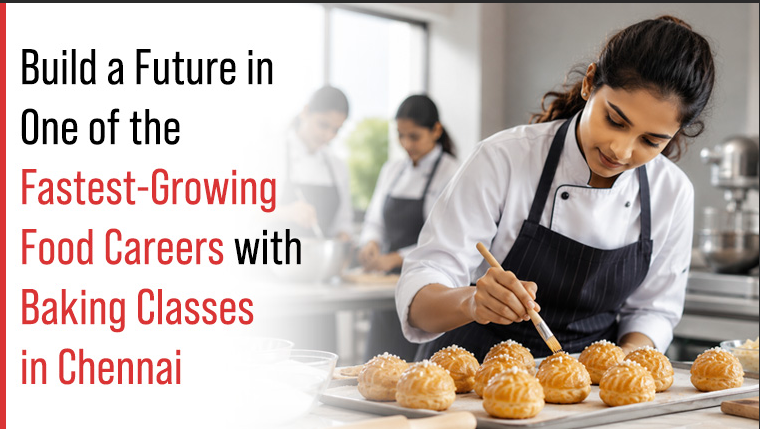

There is a moment a lot of bakers talk about, the one where baking stops feeling like something they just enjoy and starts feeling like something they could actually do. It usually happens on a quiet evening, hands still dusted with flour from a weekend experiment, staring at a cake that turned out better than expected. A small thought creeps in. What if this could be more than a hobby? For most, that thought gets pushed aside almost immediately. Practicality wins. Bills need paying, careers feel too far along to pivot, and baking still carries the label of “just a passion project” in many households. Yet for a growing number of people in Chennai, that fleeting thought has become the starting point of an entirely new career path, one built through structured bakery classes in Chennai that turn curiosity into capability.
This piece looks at why baking has quietly become one of the fastest-growing food careers in India, what actually goes into building a sustainable career from it, and why so many career-changers, homemakers, and young graduates are choosing this path over conventional options. It covers the real demand behind the trend, the skills that separate a hobby baker from a professional one, the financial realities nobody talks about enough, and how structured learning environments shape people who can genuinely compete in this space. It also addresses the doubts that hold most people back before they even start, because those doubts are usually more reasonable than aspiring bakers give themselves credit for. By the end, the goal is not to convince anyone that baking is easy. It is to show what the journey actually looks like, so the decision to pursue it becomes an informed one rather than an emotional impulse.
Why Is Baking Suddenly a Serious Career Option?
Chennai’s food culture has changed dramatically over the last decade. Café culture expanded, home bakeries multiplied on social media, and weddings and birthdays started demanding customised, Instagram-worthy desserts instead of standard bakery fare. This shift created a demand gap. There are more people who want beautifully made cakes and pastries than there are skilled professionals to make them. Baking evolved from a domestic skill into a commercial one almost overnight, and the market simply has not caught up with trained talent yet.
Is Passion Enough, or Does Skill Actually Matter?
This is where most aspiring bakers hit their first wall. Baking at home and baking professionally are not the same discipline. A home baker can afford inconsistency. A professional cannot. Client orders, catering contracts, and retail bakeries all demand repeatable results, batch after batch, regardless of humidity, ingredient batch variation, or oven temperature fluctuations. Passion gets someone through their first few cakes. Technique, measurement precision, and an understanding of ingredient science are what keep a business alive past the first six months.
What Does Structured Training Actually Add?
Self-taught bakers often reach a plateau. They can replicate recipes but struggle to troubleshoot when something goes wrong, because they never learned the underlying chemistry of baking. Structured training closes that gap. It teaches the reasoning behind a recipe, not just the steps. At Zeroin Academy, this distinction shapes how baking is taught. Instead of simply demonstrating recipes, the focus stays on building an understanding of texture, temperature, and technique that a student can apply independently, long after the class ends. That kind of grounding builds confidence that no amount of trial and error can replace quickly.
Can This Actually Become a Stable Income?
This is the question people ask quietly, almost apologetically, because they expect the answer to be discouraging. It does not have to be. Bakers today build income through multiple channels: home-based businesses, catering tie-ups, hotel and café placements, custom order services, and even baking education itself once they gain enough experience. The income is rarely instant. It builds gradually, the way most skilled trades do. But the ceiling is higher than most people assume, especially in a city where premium bakeries and dessert cafés continue opening at a steady pace.
What About the Fear of Starting Too Late?
A surprising number of people entering baking courses are in their thirties, forties, or beyond. Career transitions in food are less about age and more about consistency. Skill in baking is built through repetition, not youth. Someone who commits to structured practice for a year will often outperform someone who has baked casually for a decade without formal guidance. Age is rarely the real obstacle. Hesitation is.
Does It Really Require Constant Innovation?
Trends move quickly in this industry. What sold well two years ago may feel outdated today. But innovation is less about chasing every trend and more about understanding fundamentals well enough to adapt them. A baker who understands why a sponge rises or why a ganache splits can troubleshoot new techniques far faster than someone who only memorised finished recipes. This is why foundational training matters more than trend-chasing in the long run.
Where Does This Journey Actually Lead?
Some students go on to open home bakeries. Others join hotel kitchens or dessert cafés. A few eventually teach. The path is rarely linear, but it is almost always shaped by how seriously the foundational years were treated. Careers in baking are built slowly, layer by layer, much like the desserts themselves.
That evening moment, flour still on someone’s hands, staring at an unexpectedly good result, is often where every serious baker’s story begins. The difference between those who stop there and those who go further usually comes down to whether they gave themselves permission to take it seriously. For those in Chennai still weighing that decision, exploring baking classes Anna Nagar can be a grounded first step, not a leap of faith, but a structured one. The oven does not care about hesitation. It only responds to those willing to learn how it actually works.